Here is a thing worth noticing: the collar is the only part of your shirt that does any real work in public. The body of it disappears under a jacket. The cuffs peek out an inch if you are lucky. But the collar sits directly beneath your face, all day, framing it the way a mount frames a painting, and for most of the last two centuries, men understood that the shape of that frame said something. It could be sharp or soft, correct or reckless. It could even be removed and sent to the laundry on its own. The collar has been, at various points, a status symbol, an engineering problem, and a small act of rebellion. Two of its wilder incarnations were named, with real menace, the spearpoint and the dagger.
So let us start where the modern collar actually starts, which is not with a tailor, but with a fed-up woman in upstate New York.
A collar you could take off
Long before any of this, the collar was a separate show entirely. The Elizabethans built the ruff, that great cartwheel of pleated linen that had to be "set" with heated iron sticks and made eating a genuine hazard, and the seventeenth century relaxed it into the falling band, a soft collar that lay flat on the shoulders. The through-line across four hundred years is the same: the piece at the neck was its own object, fussed over separately from the shirt beneath it.
The version that made us modern, though, was an American laundry hack. In 1827, in Troy, New York, a woman named Hannah Montague grew tired of washing her husband Orlando's entire shirt when only the collar was ever dirty. So she did the sensible, radical thing: she cut the collar clean off and stitched on a way to fasten it back, so she could launder the grubby part alone. A local retailer and former clergyman, Ebenezer Brown, saw a housewife's shortcut and saw a business, and the detachable collar became an industry.
That industry made Troy rich. It earned the nickname it still carries, the Collar City, and by the turn of the century it was turning out detachable collars by the millions, dominated by Cluett, Peabody & Co and its Arrow brand. The starched Arrow collar was so much the picture of the well-dressed man that its advertising mascot, the impossibly handsome Arrow Collar Man, received fan mail and marriage proposals by the sackful. Collars came stiff as cardboard, some in wipe-clean celluloid, some in disposable paper, a whole vanished world of neckwear you screwed on with studs and pried off at night with relief.
The collar has been a status symbol, an engineering problem, and a small act of rebellion, sometimes all at once.
What killed it was comfort. In the 1920s the softer attached collar arrived, the shirt and its collar finally became one garment, and the great starched apparatus of Troy fell away within a generation. The detachable collar didn't die completely, it simply retreated to the two places that prize ceremony over ease, which is why, to this day, you'll still find the stiff wing collar around the necks of barristers in court and the clerical collar at the throat of a priest. Everywhere else, the collar came down, softened, and turned into the thing you're wearing now. And that is when it got interesting.
The spearpoint: the collar's swashbuckling age
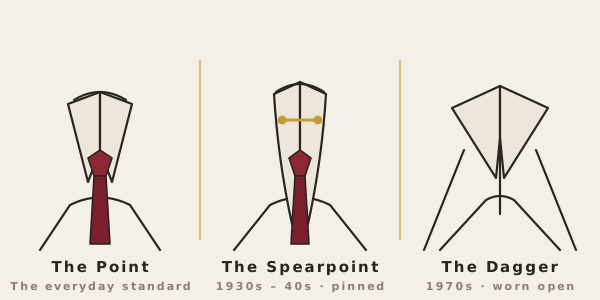
Give a man a soft attached collar and, sooner or later, he will start playing with the length of the points. In the 1930s he played hard. The spearpoint was the collar of the drape era, long, tapered leaves of three and a half to four inches, cut with a subtle teardrop curve so they seemed to lengthen the whole body. It was a genuinely dashing thing, and it did not sit still: the fabric was soft enough to need managing, so the well-dressed man ran a collar bar or a pin straight through it, cinching the two points together and levering the tie knot up and outward into a proud little arch.
The effect was the point of the whole exercise. Pinned and worn under a three-piece suit, the spearpoint's long leaves echoed the V of the lapels and drew a clean vertical line from chin to waist, the reason it looked so devastating on the leading men of the age, from the Duke of Windsor to the Hollywood set of Fred Astaire, Clark Gable, and Cary Grant. It is a collar that photographs like a held breath.
Then the war came, austerity trimmed everything, and the postwar taste turned toward shorter, cleaner, tidier lines. The swashbuckling collar looked suddenly like fancy dress, and by the 1950s the spearpoint had all but vanished, filed away as a period detail until the vintage-minded rediscovered it, which they always do.

The dagger: the collar goes to the disco
The spearpoint's disreputable grandchild arrived four decades later, and it did not bother with subtlety. The dagger collar of the 1970s took the long point and made it a weapon, broad at the base, exaggeratedly sharp at the tip, and, crucially, worn open, spread flat and splayed out over the lapels of the jacket rather than tucked beneath a tie. Where the spearpoint whispered from under a waistcoat, the dagger announced itself across a crowded room.
It was a child of its material and its moment. Cut from slippery polyester and rayon, deliberately floppy so it would fan out wide, the dagger belonged to the disco and the singles bar, rooms where the music was too loud to talk and your outfit had to do all the talking for you. Slap it over an open shirt on a lit dance floor, add John Travolta and Saturday Night Fever, and you have the single most recognizable collar of the twentieth century. Then the era ended, taste recoiled, and for a good thirty years the collar-over-the-lapel look was strictly the stuff of costume parties.
Except fashion has no memory and a very long one, both at once. Around 2021 the dagger came roaring back, the open, splayed collar on a printed silk shirt is once again everywhere, driven by the houses trading in a certain sun-drenched, Riviera-at-midnight glamour. Every time you see a colorful silk shirt worn open with its collar spread proudly over a jacket, you are looking at the dagger, reborn.
How to wear the ghosts of both
You do not need a costume to borrow from either. For the spearpoint, find a shirt with a genuinely long, soft point collar and run a collar bar beneath the knot, it is the most rakish thing you can do to a tie, and it works in exactly the same rooms a normal point collar does, only better. For the dagger, the move is easier and needs no tie at all: a well-cut printed silk shirt, worn open, the collar laid out over the jacket. One is a held breath; the other is a wink. Both descend from a woman in Troy who simply did not feel like washing a whole shirt.
And if you want to see the full family tree laid out, every collar shape and what it does to a face, this is the clearest short guide going.
A field guide to the shirt collar · point, spread, cutaway, and the long-pointed outliers
Dress for yourself, not the room. But know that the room has always read your collar first.
Whatever Suits You · Style. Sound. Substance.