There is a particular moment, familiar to anyone who writes with a fountain pen, that arrives about ninety seconds before you need to shake someone’s hand. You look down, and the side of your middle finger is blue.
It happens when you fill from a bottle. It happens when a converter seats badly. It happens when the pen has been in a bag on a flight and the pressure has done what pressure does. And it happens, most often, for no reason you can reconstruct at all.
What follows is the short version of a problem I have spent an unreasonable amount of time on.
Why soap does not work
Most fountain pen inks are water-based dye solutions, and the dye molecules are engineered to bond with cellulose fibres, which is how they stay on paper. Skin is not cellulose, but the outer layer is porous and slightly absorbent, and the dye settles into it in exactly the same way.
Ordinary hand soap is built to lift oils. Ink is not an oil. So you wash, the surface film comes away, and the stain that has gone into the top layer of skin stays exactly where it is, now slightly more set. This is why the second wash always works less well than the first.
Scrubbing does not remove the stain. It removes the skin around it and waits.
The traditional remedies are worse than they sound. Bleach and acetone will strip the colour and a good deal else besides. A pumice hand cleaner abrades the stain away along with the top of your skin. Hand sanitiser works a little, because alcohol is a better solvent for dye than soap is, but it also dries the skin badly and takes several rounds. None of these is a good answer for hands that have to look presentable.
What actually works
Amodex. It is the answer, it has been the answer for decades, and almost nobody outside the pen world knows about it.
Amodex is a thick white non-toxic cleaner, made in Connecticut, developed specifically for ink. It works by surrounding and lifting the dye rather than dissolving it, which is why it shifts fountain pen ink, ballpoint, Sharpie and printer toner without the solvents that would otherwise be required. It is water-based, biodegradable, and mild enough to use on skin without gloves.
The pen shops have known this for a very long time. Fountain Pen Hospital in New York keeps it by the register, and the same is true of most serious pen counters, which tells you more than any advertisement would.
The method, for hands
Do this dry. This is the part people get wrong, because the instinct is to run the tap first, and water dilutes the product before it has done any work.
Put a small amount on the stain with dry hands. Not much, roughly a pea. Work it in gently with a fingertip for fifteen or twenty seconds. You will see the blue lift into the white product, which is oddly satisfying and also the signal that it is working. Then, and only then, add a little water and keep working. Rinse.
One pass takes most fresh ink off completely. A stain that has been there a day or two may need a second round, but it will go. Follow with hand cream, because although Amodex is mild it is still a cleaner, and repeated use will dry your hands.
The rest of the range, and why it matters more than you think
The same product removes ink from fabric, which is the far more expensive problem. A leaking pen in a jacket pocket has ended more shirts than any other single accident in menswear.
For cloth, the method is the same in principle: work it in dry, from the back of the fabric where possible so the ink is pushed out rather than through, leave it a few minutes, then launder as normal. Do not put the garment in a dryer until the stain is fully gone, because heat is what makes an ink stain permanent. That single rule will save more shirts than any product will.
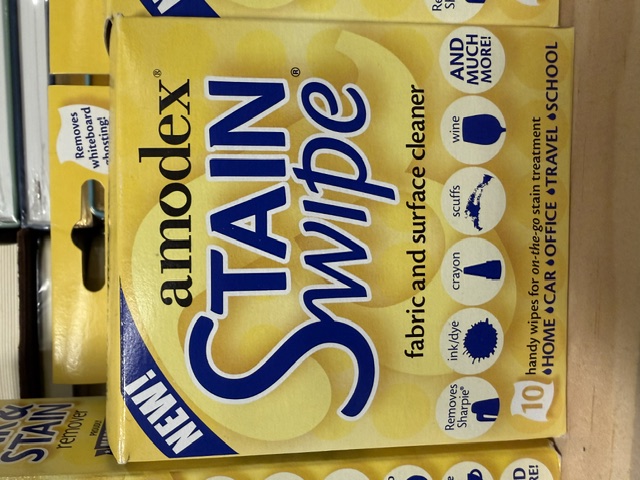
The Stain Swipe wipes pictured above are the version worth carrying. They live in a dopp kit or a briefcase and cost almost nothing, and they are the difference between a small annoyance and a ruined cuff on a day when you have somewhere to be.
Two habits that prevent most of it
Fill the pen over a folded paper towel, and wipe the section and the nib properly afterwards, including the little collar where ink hides and later creeps out onto your fingers. Most stained hands come from a filling done in a hurry.
And carry the pen nib-up. Ink follows gravity, air expands and contracts with altitude and heat, and a pen lying nib-down in a warm bag is a pen preparing to make a point.
None of this is an argument for using a ballpoint. Stained fingers are a small tax on a real pleasure, and the tax is refundable.
Whatever Suits You · Style. Sound. Substance.